Download Mendeley
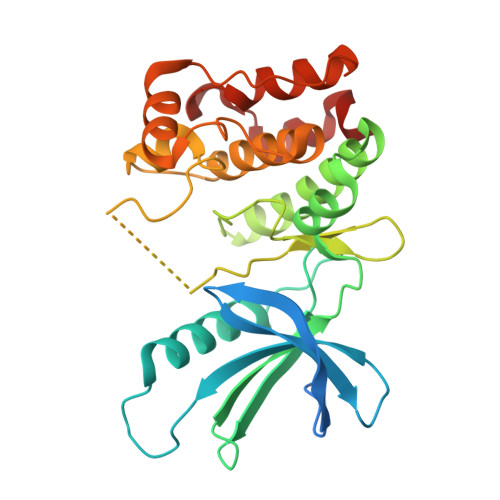
Structural basis for MEKK2 dimerization and substrate recognition.
Vish, K.J., Huet-Calderwood, C., Ha, B.H., Calderwood, D.A., Boggon, T.J.(2025) Nat Commun
- PubMed: 41318559
- DOI: https://doi.org/10.1038/s41467-025-66884-5
- Primary Citation of Related Structures:
9P6A - PubMed Abstract:
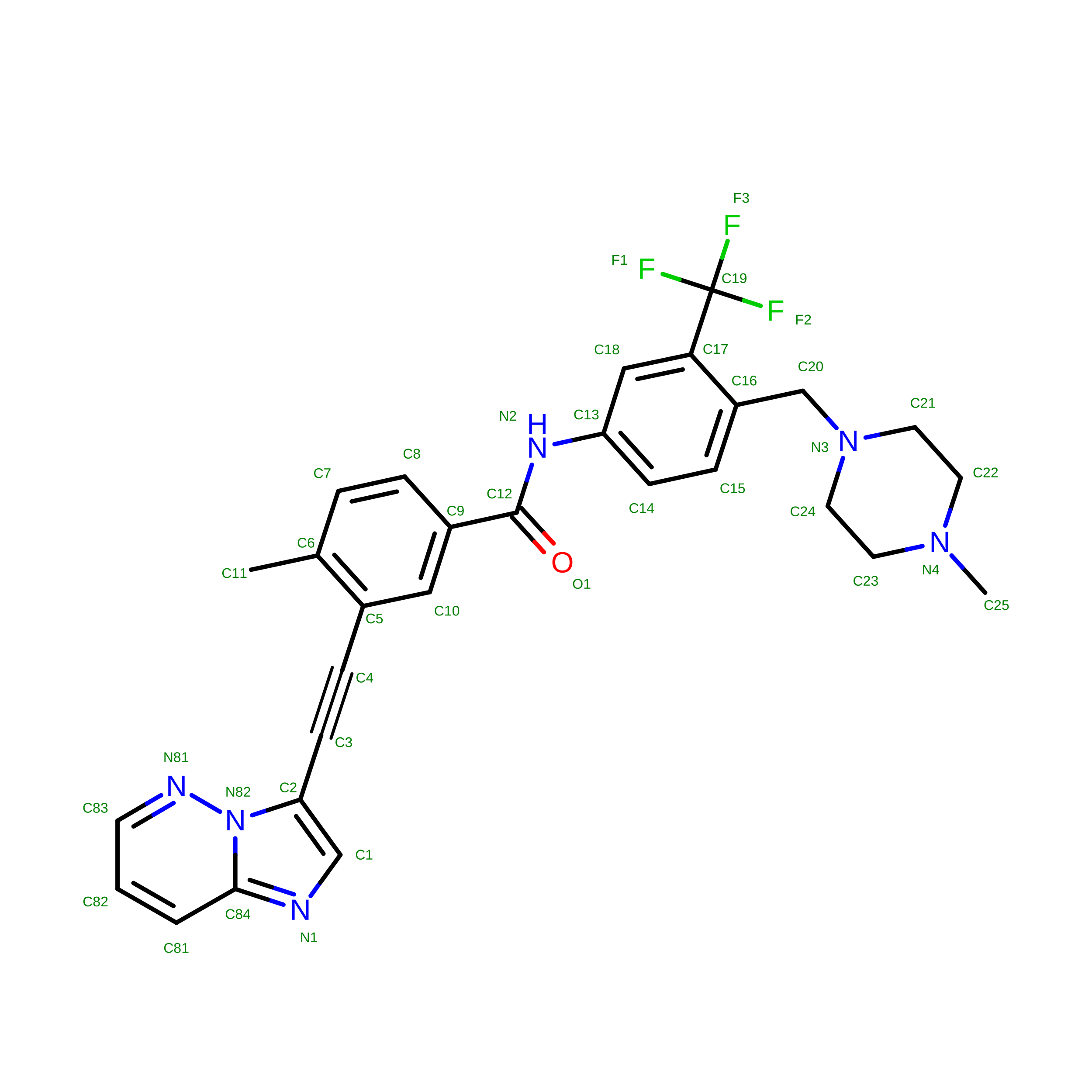
Signaling downstream of Mitogen-Activated Protein Kinase Kinase Kinases (MAP3K) is promiscuous. In the vascular and immune systems the MAP3K, MEKK2, activates different substrates, but the mechanisms of substrate targeting have not been delineated. Here, we determine the 2.4 Å crystal structure of the MEKK2 kinase domain in complex with the small molecule inhibitor, ponatinib. We find that MEKK2 dimerizes by a surface centered on the αG helix and the C-terminal region of the activation segment, that this surface is important for MEKK2 autophosphorylation and dimerization, and that this surface is conserved with MEKK3. We then assess the importance of the surface for phosphorylation and recruitment of two MAP2K substrates, MEK5 and MKK6. We find that both MEK5 and MKK6 require the αG helix-mediated interaction for phosphorylation. In contrast, MEKK2 recruitment of MEK5 is dependent on PB1 domain interactions but MKK6 recruitment is associated with the αG helix-mediated interaction. Our study therefore provides a framework to understand diverse substrate targeting by the MAP3Ks, MEKK2 and MEKK3.
- Department of Molecular Biophysics and Biochemistry, Yale University, New Haven, CT, USA.
Organizational Affiliation: