






9XBN | pdb_00009xbn

Cryo-EM structure of Sup35NM fibril formed at 4 degrees (Sc4)

  • Classification: PROTEIN FIBRIL
  • Organism(s): Saccharomyces cerevisiae
  • Expression System: Escherichia coli
  • Mutation(s): No 

  • Deposited: 2025-10-24 Released: 2025-12-10 
  • Deposition Author(s): Nomura, T., Boyer, D.R., Tanaka, M.
  • Funding Organization(s): Japan Agency for Medical Research and Development (AMED), Japan Society for the Promotion of Science (JSPS), Human Frontier Science Program (HFSP), National Institutes of Health/National Institute of General Medical Sciences (NIH/NIGMS), National Institutes of Health/National Institute on Aging (NIH/NIA)

Experimental Data Snapshot

  • Method: ELECTRON MICROSCOPY
  • Resolution: 3.10 Å
  • Aggregation State: FILAMENT 
  • Reconstruction Method: HELICAL 

wwPDB Validation   3D Report Full Report


This is version 1.0 of the entry. See complete history


Literature

How Sup35 monomer conformation and amyloid fibril polymorphism determine yeast strain phenotypes.

Tanaka, M.Nomura, T.Boyer, D.Komi, Y.Ge, P.Maillard, R.A.Rodriguez, P.Yamagata, A.Shirouzu, M.Legname, G.Samori, B.Eisenberg, D.

(2025) Res Sq 

  • DOI: https://doi.org/10.21203/rs.3.rs-7945345/v1
  • Primary Citation of Related Structures:  
    9XBK, 9XBL, 9XBM, 9XBN, 9XBO, 9XBP

  • PubMed Abstract: 

    In the [ PSI + ] prion system, the yeast prion protein Sup35 can form structurally distinct amyloid fibrils that lead to distinct transmissible prion states, or strains. However, our understanding of how different Sup35 fibril structures arise and translate to phenotypic variations is limited. Here, using cryo-EM and single-monomer force spectroscopy with optical tweezers, we reveal the structural basis of yeast prion propagation in four wild-type and S17R mutant variants of Sup35 that underlie different [ PSI + ] strains. Cryo-EM structures show that the four variants form strikingly distinct fibril structures, which exhibit varying stability and chaperone-accessibility. Force spectroscopy suggests the different distinct fibril structures are derived from distinct monomer conformational ensembles. Further, cryo-EM structures indicate that prion strain strength is correlated with enhanced fibril propagation caused by a combination of low fibril stability and a large separation between the Sup35 fibril core and the Ssa1/Sis1 chaperone-binding region. These results provide a structure-based mechanism for the yeast prion strain phenomenon with implications for understanding amyloid propagation in human neurodegenerative diseases.

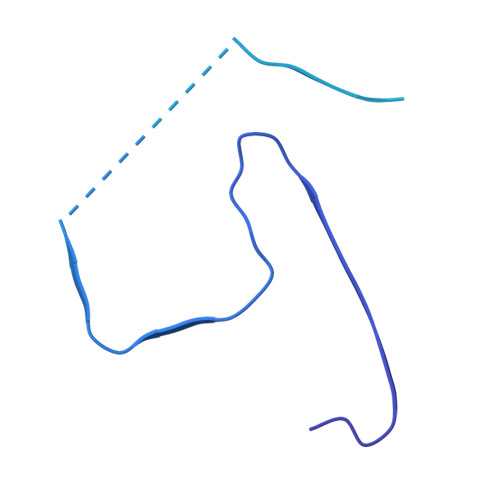

Macromolecules
Find similar proteins by:  (by identity cutoff)  |  3D Structure
Entity ID: 1
MoleculeChains Sequence LengthOrganismDetailsImage
Eukaryotic peptide chain release factor GTP-binding subunit
A, B, C, D, E
260Saccharomyces cerevisiaeMutation(s): 0 
Gene Names: SUP35GST1PNM2SAL3SUF12SUP2YDR172WYD9395.05
EC: 3.6.5
UniProt
Find proteins for P05453 (Saccharomyces cerevisiae (strain ATCC 204508 / S288c))
Explore P05453 
Go to UniProtKB:  P05453
Entity Groups  
Sequence Clusters30% Identity50% Identity70% Identity90% Identity95% Identity100% Identity
UniProt GroupP05453
Sequence Annotations
Expand
  • Reference Sequence
Experimental Data & Validation

Experimental Data

  • Method: ELECTRON MICROSCOPY
  • Resolution: 3.10 Å
  • Aggregation State: FILAMENT 
  • Reconstruction Method: HELICAL 
EM Software:
TaskSoftware PackageVersion
MODEL REFINEMENTPHENIX1.21_5207
RECONSTRUCTIONRELION

Structure Validation

View Full Validation Report


Entry History & Funding Information

Deposition Data


Funding OrganizationLocationGrant Number
Japan Agency for Medical Research and Development (AMED)Japan21gm1410009
Japan Society for the Promotion of Science (JSPS)Japan20H00501
Japan Society for the Promotion of Science (JSPS)Japan24H00603
Japan Society for the Promotion of Science (JSPS)Japan21H05257
Human Frontier Science Program (HFSP)FranceRGP0010/2011
National Institutes of Health/National Institute of General Medical Sciences (NIH/NIGMS)United StatesR01GM032543
National Institutes of Health/National Institute on Aging (NIH/NIA)United StatesRF1AG048120
National Institutes of Health/National Institute on Aging (NIH/NIA)United StatesR01AG070895
Japan Society for the Promotion of Science (JSPS)Japan22K15067
Japan Society for the Promotion of Science (JSPS)JapanJP25830025
National Institutes of Health/National Institute of General Medical Sciences (NIH/NIGMS)United States1R24GM154186

Revision History  (Full details and data files)

  • Version 1.0: 2025-12-10
    Type: Initial release




